


Introduction
Most businesses think about website maintenance and support as a cost. A line item on the budget. A monthly fee that keeps things running the way they should. Something necessary but not particularly exciting.
This is the wrong frame entirely.
Consistent website maintenance and support is one of the highest-return investments a business makes in its digital presence — but the returns are largely invisible when the plan is working correctly. Nobody celebrates the security breach that never happened. Nobody measures the revenue from the page that loaded in 1.8 seconds instead of 4.2. Nobody quantifies the leads that converted because a form worked flawlessly on a Tuesday afternoon instead of throwing an error.
The ROI of website maintenance is hidden because it lives in the gap between what happened and what would have happened without it. This guide makes that gap visible — in real numbers, real scenarios, and a clear framework for calculating the return your maintenance investment is already delivering, whether you can see it or not.
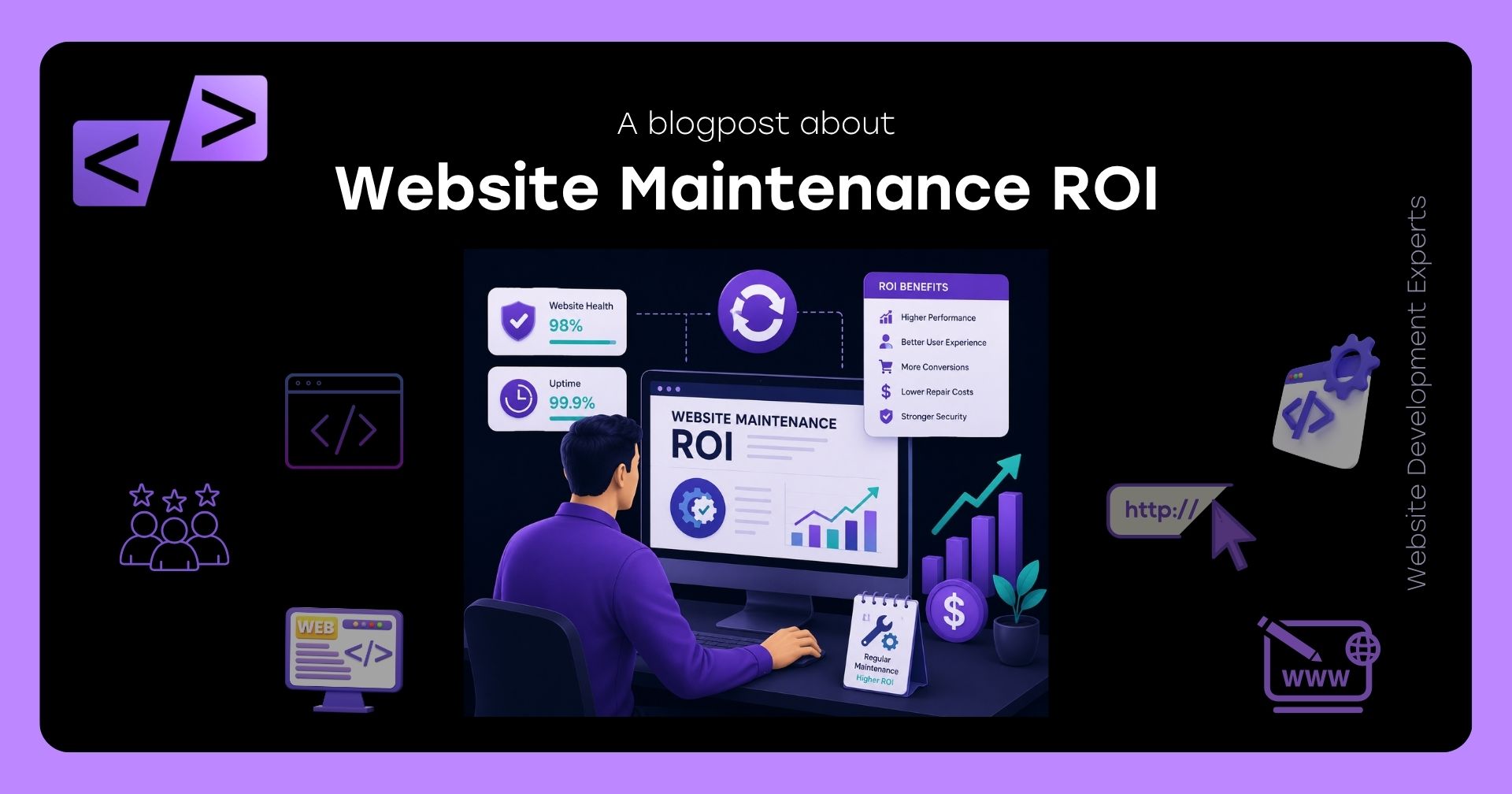
Consistent maintenance is one of the highest-ROI digital investments you can make.
Why the ROI of Maintenance Is Hidden — and Why That Makes It Dangerous
The hidden nature of maintenance ROI is precisely what makes businesses underinvest in it. When a maintenance plan is working, nothing dramatic happens. Sites stay up. Forms work. Security holds. Rankings hold. Conversions flow. The absence of problems is invisible — and invisible returns are easy to cut when budget pressure arrives.
The mistake becomes clear only after the fact. When the security breach happens. When the site crashes during a product launch. When rankings drop after three months of technical degradation. When the checkout form that was broken for two weeks finally gets reported by a customer.
Regular maintenance prevents downtime, builds customer trust, and protects your revenue stream. When your site runs smoothly, customers can rely on your services 24/7. Key statistic: 88% of online consumers will not return after technical issues — making reliability crucial for customer retention.
The ROI of consistent website maintenance and support operates across six distinct dimensions — each of which has measurable business value that most organizations never quantify because they never experience the loss that would make it visible.
ROI Dimension #1: Uptime Revenue Protection
Downtime is the most immediately quantifiable cost of inadequate maintenance — and the easiest to calculate.
For e-commerce sites, even one hour of downtime can equal $1,000 or more in lost sales. Monitoring tools and uptime alerts act as an early warning system, so issues can be fixed before they affect customers.
But downtime cost is not just the direct revenue lost during the outage. It includes:
- Immediate revenue loss: Every transaction that would have occurred during the downtime window
- Bounce rate damage: Users who arrived during downtime and left permanently — a percentage of whom never return
- SEO impact: Extended downtime triggers crawl errors in Google Search Console that can affect indexing and ranking signals
- Reputation damage: Social media amplification of outages is faster and wider than ever — a two-hour outage in 2026 can generate negative brand mentions that persist in search results for months
- Customer trust erosion: 88% of online consumers will not return after a bad technical experience — making a single significant outage a permanent customer loss event at scale.
The uptime ROI calculation:
A business generating $15,000 per month in online revenue ($500 per day, $21 per hour) that experiences two unplanned outages per quarter — each averaging 4 hours — loses approximately $168 in direct revenue per outage, or $672 annually from direct loss alone.
But the true cost multiplies when customer lifetime value is factored in. If each outage results in 10 permanently lost visitors with an average customer lifetime value of $800, the annual customer attrition cost exceeds $16,000 — on top of the direct revenue loss.
Professional uptime monitoring with 1-minute check intervals and instant alerting — a standard component of professional website maintenance and support — catches outages within minutes rather than hours, limiting direct revenue loss and virtually eliminating the customer attrition cost from extended downtime.
ROI Dimension #2: Security Breach Prevention
Security maintenance ROI is the most dramatic of all the hidden dimensions — because a single prevented breach can return the cost of years of maintenance in a single event.
Documented cases show organizations investing $50,000 in proactive disaster recovery protecting $900,000 in revenue — a 1,700% return.
The cost of a security breach in 2026 extends far beyond the technical remediation:
- Emergency developer costs: Security incident response at emergency rates — typically 2 to 3 times standard developer fees — often running $5,000 to $50,000+ depending on breach severity
- Data breach notification costs: Legal requirements under GDPR and CCPA mandate user notification for data breaches — with associated legal fees, notification infrastructure, and potential credit monitoring services
- Regulatory fines: GDPR fines for data breaches can reach 4% of annual global turnover or €20 million, whichever is higher — a potentially existential cost for SMBs
- SEO penalties: Google Safe Browsing flags hacked sites — removing them from search results or displaying security warnings that eliminate organic traffic until the site is cleaned and reviewed
- Reputation damage: Statistics show that 83% of compromised websites were using outdated software with identified vulnerabilities that could easily have been fixed. 43% of cyberattacks specifically target small businesses because spammers perceive unmaintained websites as easy targets.
The security ROI calculation:
A professional maintenance plan for a small business website costs approximately $3,600 to $9,600 per year. A single significant security incident — malware injection, data theft, or ransomware — costs a minimum of $5,000 to $25,000 to remediate, plus the unmeasured cost of traffic loss during the Google Safe Browsing penalty period, which typically lasts 2 to 8 weeks.
A maintenance plan that prevents one significant security incident over three years returns its full three-year cost in that single prevention — and has also delivered three years of uptime protection, performance optimization, and SEO health maintenance as additional returns on top of the security investment.
ROI Dimension #3: Conversion Rate Preservation and Improvement
This is the dimension of maintenance ROI that is most consistently underestimated — because its impact on revenue is continuous, compounding, and completely invisible without measurement.
Businesses that maintain their sites see conversion rates 30% higher than those that do not.
Performance degradation is the primary mechanism by which unmaintained websites lose conversion revenue. As content grows, images are added without optimization, third-party scripts accumulate, and Core Web Vitals scores decline — each increment of performance degradation extracts a measurable toll on conversion rates.
A one-second delay in page load time can reduce conversions by 7%. Website speed is not just a technical metric — it directly impacts the bottom line.
The conversion rate ROI calculation:
A business website receiving 5,000 monthly visitors at a 2.5% conversion rate generates 125 conversions per month. With an average conversion value of $200, that is $25,000 per month in revenue.
Without active performance maintenance, page load time increases from 2.1 seconds at launch to 4.3 seconds 18 months later — a realistic degradation rate for an unmaintained site with active content publishing. At 4.3 seconds, the conversion rate drops to approximately 1.8% — 90 conversions per month, or $18,000.
The $7,000 per month revenue difference — $84,000 annually — is entirely attributable to performance degradation that professional website maintenance and support would have prevented. The annual maintenance cost of $5,000 to $9,000 delivers an $84,000 revenue protection return.
That is not a cost. That is an investment with returns that compound every month the site performs well.
ROI Dimension #4: SEO Ranking Protection and Compounding Organic Value
Organic search traffic is, for most businesses, the highest-value traffic source — highest intent, lowest acquisition cost, most consistent. It is also the traffic source most directly dependent on consistent website maintenance and support.
Search engines like Google analyze website health — Core Web Vitals, E-E-A-T signals, broken links, outdated meta tags, and stagnant content. A website that has not been audited for a whole year is often full of broken links, outdated meta tags, and stagnant content — and search engines consider this a dead site.
If you are not maintaining your website, your competitors are — and they are moving ahead. Every performance improvement, content update, and technical fix widens the gap in rankings, user experience, and conversions. That gap does not stay static. It compounds. And once competitors build authority, catching up costs far more than maintaining your position.
The SEO ROI calculation:
A business ranking on page one for five commercial keywords generating 2,000 monthly organic visitors at a 3% conversion rate produces 60 conversions per month at $300 average value — $18,000 in monthly organic revenue.
Without maintenance, Core Web Vitals scores decline, broken links accumulate, schema markup becomes invalid, and crawl errors go unresolved. Over 12 months, these technical signals push the site from page one to page two for three of its five ranking keywords — reducing monthly organic visitors by 40% (to 1,200) and conversions by the same proportion (to 36 per month, or $10,800).
The $7,200 per month revenue difference — $86,400 annually — represents the SEO value destroyed by deferred maintenance. Since 75% of users never scroll past page one of search results, maintaining your website ensures you stay visible to potential customers — and the cost of recovering lost rankings is consistently higher than the cost of maintaining them.
ROI Dimension #5: Emergency Cost Avoidance
Emergency web development work is expensive in ways that go beyond the hourly rate. It disrupts operations, consumes leadership attention, creates reputational urgency, and often requires decisions made under pressure that produce suboptimal long-term outcomes.
A hacked site or a failed plugin can lead to urgent repairs that cost hundreds per hour. Planned updates and consistent monitoring prevent those spikes in web maintenance fees.
The emergency cost avoidance ROI calculation:
Reactive emergency development work typically costs 1.5 to 3 times standard development rates. For a developer charging $150 per hour at standard rates, emergency work runs $225 to $450 per hour.
A business experiencing two significant incidents per year — each requiring 8 hours of emergency remediation — pays $3,600 to $7,200 in emergency developer costs annually, in addition to the revenue lost during the incident period.
A professional maintenance plan at $5,000 to $8,000 per year eliminates both the emergency costs and the revenue loss — delivering a net return from emergency cost avoidance alone that approaches or exceeds the full cost of the maintenance engagement.
ROI Dimension #6: Brand Trust Compounding
This is the most difficult dimension of maintenance ROI to quantify — and the one with the longest time horizon. Brand trust, once built, reduces customer acquisition costs, increases repeat purchase rates, and generates word-of-mouth that no paid channel can replicate. And it is built or destroyed, one interaction at a time, by the quality of experience your website delivers.
In 2026, prospects make snap judgments. A clunky mobile experience actively erodes trust before you ever get a chance to speak. Consistent upkeep is the only way to protect your initial investment and ensure your digital asset continues to deliver a positive return for years.
Outdated layouts, slow pages, or broken buttons can reduce engagement and sales. Regular UX testing helps identify friction points before they cost you real money.
Brand trust compounds in a direction — either toward increased authority and lower acquisition costs, or toward eroded credibility and higher churn. Website maintenance and support is the ongoing investment that keeps that compounding running in the right direction.
The Hidden ROI Framework: Calculating Your Maintenance Return
The ROI of website maintenance can be calculated directly once you understand its six dimensions. Here is the framework:
ROI Formula:
Maintenance ROI = (Total Protected + Generated Value − Maintenance Cost) ÷ Maintenance Cost × 100
Where Total Protected + Generated Value includes:
- Uptime revenue protection: (Monthly revenue ÷ 720 hours) × average incident hours prevented × incidents prevented annually
- Security breach avoidance: (Probability of incident without maintenance) × (average breach remediation cost + revenue loss during recovery)
- Conversion rate preservation: (Baseline monthly revenue) × (conversion rate differential between maintained and unmaintained site) × 12
- SEO value protection: (Monthly organic revenue) × (ranking retention rate differential) × 12
- Emergency cost avoidance: (Incidents avoided × emergency hours × emergency rate differential)
- Brand trust value: (Customer lifetime value × retention rate differential) × monthly visitors
For most businesses, even a conservative calculation across three or four of these dimensions produces a maintenance ROI that significantly exceeds 100% — meaning the investment returns more than it costs, often by a factor of 3 to 10 or more.
The Hidden Costs of NOT Maintaining: The Full Picture
The ROI Comparison: Maintenance Investment vs. No Maintenance Over 3 Years
How to Make the Maintenance ROI Visible to Your Organization
The biggest challenge with maintenance ROI is organizational: when the plan is working, there is nothing dramatic to report. Leadership sees the cost. They do not see the avoided breach, the preserved ranking, the conversion that completed because the page loaded in 1.8 seconds instead of 4.1.
Making maintenance ROI visible requires deliberate measurement and reporting:
Metrics to track and report monthly:
- Uptime percentage and downtime minutes (with revenue equivalent)
- Core Web Vitals scores over time vs. baseline at launch
- Organic search traffic trend and ranking position for key commercial terms
- Conversion rate trend vs. historical baseline
- Security incidents detected and resolved (versus those that escalated)
- Backup restoration test results and RTO performance
- Emergency developer hours avoided (estimated)
How to present maintenance ROI in quarterly business reviews:
Frame each metric as a business outcome — not a technical report. "Our Core Web Vitals score is 91" does not resonate with business stakeholders. "Our page performance maintained the 2.1-second load time that contributed to our 3.2% conversion rate — versus the industry average of 1.7% for sites in our load time range" does.
Present those results during quarterly reports to demonstrate clear ROI. The goal is to make the maintenance investment as visible as any other revenue-generating activity in the business — because it is one.
Conclusion
The ROI of consistent website maintenance and support is not hidden because it does not exist. It is hidden because it lives in the problems that never became incidents, the rankings that never dropped, the conversions that completed without friction, and the customers who never encountered an error that sent them to a competitor.
When you add up what maintenance protects — uptime revenue, security integrity, conversion rates, organic rankings, emergency cost avoidance, and brand trust compounding — the investment case is not just positive. It is one of the strongest ROI stories in a business's entire digital budget.
At WebsiteDevelopmentExpert.com, led by Dr. Zaid Altahat — Ph.D. in Computer Science and 20+ years of engineering at Motorola, GE Healthcare, and Baxter — website maintenance and support is not a separate offering. It is an integral part of every development engagement we build. We monitor proactively, patch promptly, optimize continuously, and report transparently — because we understand that the hidden ROI of maintenance is the return that accumulates every month your website performs exactly as it should.
Whether you need maintenance for a custom web application, a high-traffic business platform, or a custom website, we provide the structured, enterprise-grade support that keeps your investment performing and your hidden ROI compounding.
FAQs
What is the ROI of website maintenance and support?
The ROI of website maintenance operates across six dimensions: uptime revenue protection, security breach prevention, conversion rate preservation, SEO ranking protection, emergency cost avoidance, and brand trust compounding. When calculated across all six dimensions, most businesses find that professional website maintenance returns 3 to 10 times its annual cost in protected and generated value — making it one of the highest-ROI digital investments available. The challenge is that most of this return is hidden in avoided losses rather than visible gains.
How do I calculate the ROI of my website maintenance investment?
Use the formula: Maintenance ROI = (Total Protected and Generated Value − Maintenance Cost) ÷ Maintenance Cost × 100. Total protected value includes: uptime revenue protected (monthly revenue divided by hours, multiplied by downtime hours prevented); security breach avoidance (breach probability without maintenance multiplied by average remediation cost); conversion rate preservation (revenue difference between maintained and degraded conversion rates annualized); SEO value protection (organic revenue differential from maintained versus declining rankings); and emergency cost avoidance (incidents prevented multiplied by emergency rate differential).
Why is website maintenance ROI described as "hidden"?
Maintenance ROI is hidden because it lives in problems that never became incidents. When a security patch prevents a breach, there is no breach to measure. When performance monitoring prevents a conversion rate decline, the conversions that completed are indistinguishable from any other traffic session. When uptime monitoring catches an outage in four minutes instead of four hours, only the four minutes of downtime appears in the log — not the four hours that would have occurred without monitoring. The returns are real and substantial, but they require deliberate measurement to make visible.
How does website maintenance impact SEO rankings specifically?
Website maintenance directly impacts SEO through six technical channels: Core Web Vitals scores (a direct Google ranking signal) which degrade without active optimization; broken link accumulation which signals quality problems to crawlers; schema markup validity which determines eligibility for rich SERP features; crawl error accumulation in Google Search Console which affects index coverage; sitemap accuracy which guides crawler prioritization; and page speed which affects both ranking signals and user experience metrics like bounce rate and time on site. All six degrade without active maintenance — and all six improve with it.
Is professional website maintenance and support worth the cost for small businesses?
Especially for small businesses, where organic search traffic typically represents the highest proportion of total leads and the budget for recovering lost rankings is most constrained. A small business website depending on page-one rankings for five commercial keywords can lose $8,000 to $50,000 annually in organic revenue when technical degradation pushes those rankings to page two — a loss that a $3,600 to $5,000 annual maintenance plan would have entirely prevented. Consistent website maintenance and support is one of the highest-ROI investments a small business makes in its digital presence precisely because the downside of neglect is so disproportionate to the cost of prevention.

